
Our solutions are built on technology from these trusted industry leaders.


Many business owners actually face pressure to expand their corporate leadership team to manage their technology. There are plenty of “experts” who claim that a growing business cannot survive without hiring both a Chief Information Officer and a Chief Technology Officer. Unfortunately, this leaves an organization looking at hundreds of thousands of dollars in extra executive salaries.
You do not need to empty your company bank account to get the benefit of these distinct technical mindsets. To make the best decisions for your organization, you need to understand exactly what these two roles do and how their strategic responsibilities differ.
If you’re a business owner, you likely view IT as a necessary evil. It’s that line item on your profit and loss report that feels like a black hole; money goes in, and occasionally, your printer still doesn’t work.
The hard truth is that if you are still calling a tech person only when things break, you are paying a hidden tax on your own growth.
How do you know when it’s time to fire one of your vendors? Better yet, how do you know when you’re better off firing your IT vendor to find a better option? These kinds of situations can be stressful, but they’re not impossible. We’re here to help you make the call, as well as to offer a better alternative that saves you time, energy, and money.
Surprises can be exciting, but one part of your business where you don’t want them is in your IT. A server crash, a wireless connectivity outage, or a security threat can all create multiple surprise problems that you simply aren’t ready to handle—particularly in the realm of your wallet. Instead of spinning the wheel and gambling on your IT bill, you can instead treat your IT like a predictable utility cost, and it’s all thanks to proactive managed IT services.
When something goes wrong with your company’s technology, the last thing you want to do is be the one at fault. Unfortunately, that’s what comes with the territory in the world of business IT. If you’re sick of technicians who make excuses rather than own up to their mistakes and correct their course, read on. We’re going to showcase just what accountability in IT looks like and how we strive to embody it.
Let me ask you something… Do you know just how much IT downtime costs? For SMBs, it’s typically between $427 to over EIGHT GRAND an hour. Imagine your whole workforce just chillin' because the Internet's down, meanwhile deadlines are getting missed, customers are getting ticked off, and opportunities are disappearing. That's a nightmare, man.
This is why you need to do what you need to do to keep your business up and running.
In business, it’s tempting to think, if it's not broken, don't fix it. This is especially true for technology. Your computers turn on, emails go out, and things seem to work… so why bother with constant maintenance?
What if I told you this safe approach is actually draining your profits? It’s a hidden expense, and understanding it can completely change how you see your IT.
Throughout the workday, you’re likely juggling a multitude of responsibilities, from strategic planning to ensuring smooth day-to-day operations. Let’s face facts here: technology underpins nearly every aspect of your business… but what happens when that technology falters?
Reactive fixes can be costly, disruptive, and ultimately hinder your growth. This is where the power of proactive business technology support truly shines.
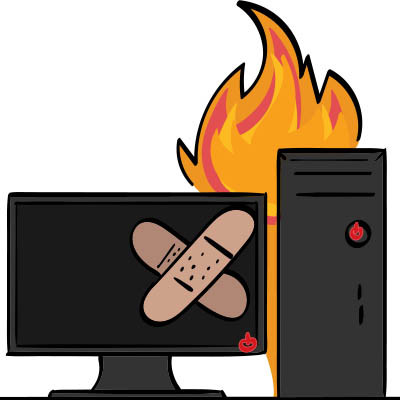
Imagine owning an elevator that you would only service if it broke down? Sounds ridiculous, right? Well, that’s exactly what businesses do when they rely on a break/fix IT strategy.
Break/fix IT means waiting until something goes wrong before calling in the experts. While this might seem like a cost-saving move, in reality, it’s a fast track to frustration, downtime, and lost revenue. Let’s break down why this approach makes no sense in today’s business world.
Small and medium-sized businesses (SMBs) face the challenge of managing complex IT systems with very limited resources. Enter managed service providers, or MSPs, the guardians of IT that can help your business stay ahead of the game. An MSP's approach to IT support delivery offers many benefits that traditional IT support and even an in-house team might struggle to match.
Let's delve into three compelling reasons why our innovative approach is best for your IT support needs, especially if you want to scale up and streamline operations.
We love to highlight how technology helps businesses thrive, particularly small and medium-sized businesses with a lot of growth potential but limited by their budgets. This is why we provide SMBs with managed IT services specifically designed to drive business growth. If you have yet to consider outsourcing your IT needs, you could be missing out on a golden opportunity to alleviate many of the pain points your organization suffers from on a daily basis.
With technology being so important for all businesses in at least some capacity, it’s no small wonder that effectively using it (and having someone on-hand to manage it all) is tremendously valuable for any company. This is where a managed service provider (MSP) can be helpful, even for businesses that have a dedicated IT department. All small businesses benefit from working with an MSP.
What makes a small to medium-sized business so different from a large, enterprise-sized one? The amount of people and moving parts, of course, but if you really consider it, there isn’t all that much. This is why when looking to control your small business’ IT support costs, choosing managed IT services is a good option. This month, we thought we’d take a look at some of the other benefits managed IT can bring your organization:
As much as we hate to admit it, the first thing that many people still think of when they hear the term “tech support” is the experience that comes with an antiquated approach to technology services: the break/fix method. Fortunately for us, we are seeing many businesses make the better decision, and turn to the clearly superior option, managed IT.
Small and medium-sized businesses (SMB) have historically been restricted in what they can do with their technology infrastructures. However, there are now options that an SMB can leverage that enable it to accomplish more with their infrastructure - but this requires the SMB to have a plan in place.
When it boils down to it, there are really only two ways to operate a business: proactively, or reactively. While many businesses still rely on their reactivity to deal with their technology issues, the opposite approach is demonstrably more effective for the modern business. Let’s explore some of the effects that a proactive and reactive strategy can each have on your operations.
Get the Knowledge You Need to Make IT Decisions
Technology is constantly evolving, and keeping up can feel overwhelming. Whether you want to understand cybersecurity threats, explore automation, or learn how regulations like PCI DSS impact your business, we’ve made it easy to access clear, straightforward insights on key IT topics.
Learn more about what Telesys IT Services can do for your business.
Fort Worth - (817) 590-9339
Dallas - (972) 398-0818
Austin - (512) 899-1800
Telesys IT Services
6840 Boulevard 26
Fort Worth, Texas 76180